Showing posts with label Alps. Show all posts

Saturday, 8 February 2014

The French guide to skiing

Today marks the end of my three-week skiing odyssey in France.

This has been my first time skiing in Europe and I'm more than happy to report that, apart from having all my bones intact, it's been one of my best ski escapes.

I've shivered on the ski lifts, ploughed through powder, scrapped down icy slopes, fallen over a few times, almost got lost in whiteouts, and watched my nose peel.

Yes, it's been fantastic.

Hopefully, I've even improved my skiing a little bit.

The skiing at Val d'Isere, Les Arcs and Val Thorens has been sublime and some of the best I've ever encountered thanks to enormous interconnected ski areas, good snowfall, and a diverse choice of runs.

Here you get a real sense that you are in one of the global heartlands of alpine skiing.

Most of all, it's been incredible to stand on the snowy summits of the expansive French Alps.  On a sunny day and under clear blue skies, white mountain peaks stretch out as far as the eye can see.

In amongst all of this, I've also discovered seven curiosities about skiing in France, compared to Japan, Canada and the US.

1.  Haute cuisine high in the hills
I've never been to a ski resort that has had a single, let alone multiple, dedicated fromageries (cheese shops), patisseries or charcuteries (specialists in prepared meats).  For the French it seems being 2,000 metres above sea level is no excuse to scrimp on the finer things in life.  The standard of slope-slide food is also substantially higher than in many other countries.  Forget just burgers and chips for lunch, here it's freshly-baked quiches, tartiflettes, pastries, baguettes and other delicacies from the Savoie region.

Cured meats from the Savoie region

2. Dogs share the slopes 
As I flagged in my previous blog, the French Alps, like the rest of Europe, is more dog friendly than any other ski destination I've been to.   While they're not strapping on skis and taking to the slopes just yet, these dogs do command the villages in the evening when they come out to run and roll in the snow.

Dog eyes off its territory

3. Not all the air is fresh
How do you celebrate an invigorating ski down a long slope in the French Alps?  Apparently, it's by lighting up a cigarette or even a pipe if the mood takes you.  Sadly, Europe still loves a good smoke and liberal laws means it's everywhere - on the lifts, in the lift lines, on the slopes and in the outdoor eating areas.


4.  It's never too cold to sit outdoors
In Australia, we avoid alfresco dining when the mercury dips below 20 degrees Celsius (unless there's a heater).   If it's a sunny day in the the French Alps, skiers love nothing more than sitting outside, even if it is well below freezing.   Armed with a chocolat chaud or vin chaud, they look as though they're on the pool deck of a Pacific island cruise ship.  Where was I?  Sitting inside by the heater.

Sun lounges lined up on the summit


5.  The outdoor fun has just begun when the lifts close for the day
The French Alps knows how to do "apres ski".  Whether it's a sugar crepe, nutella waffle or vin chaud from an outdoor kiosk or cafe, or the more energetic outdoor dance parties in your ski boots, there's an option for everyone.  Elaborating on the last point, it seems only blizzard conditions warrant taking the apres-ski celebrations indoors.

Vin chaud - purely medicinal after a day of skiing

6.  Cold?  What cold?  
When I ski, I wear a helmet, thick neck warmer and five layers of clothing, making sure not a fraction of skin is left exposed to the icy winds.  Meanwhile, my French Alps counterparts rock up for skiing in a headband and sunnies (and even the occasional tshirt and jeans) like it's a day at the beach.   I can only imagine all the nerve endings in their skin have been frozen.


7.  Watch your head!
Skiers here seem to lower the ski lift bar without warning within milliseconds of sitting down, usually while I'm still getting myself in order.  Just as well I wear a helmet as I've been whacked on the back of the head by the descending bar on an hourly basis.

Warning: bar coming down!

However, it's not all foreign in the French Alps.  It seems no matter where you are in the world, these three slope-side staples remain:

1. Snowboarders still behave... well... like snowboarders
They still love collapsing in a group in the middle of the slope, usually just below the crest of a hill so the downstream traffic can't see them until the last minute. The threat of having their spine severed by a wayward ski doesn't seem to phase them.

2. Skiers still behave... well... like skiers
Groups of skiers still love congregating at the crest of hills (maybe to check if there any snowboarders below?) effectively cutting of the slope to anyone else.  Be ready to break!

3. The smell of pot still lingers in the air around ski lifts
It's not just tobacco you're smelling here.  You would think I was skiing in Colorado (which has just legalised marijuana) given the amount of pot that's being smoked.


Saturday, 1 February 2014

Puppy hour in the French Alps

It's that time of the day when the ski lifts are closing on the French Alps.

Weary skiers and boarders are heading inside to reheat their toes and fingers.

Some skiers are enjoying a vin chaud as part of their apres-ski ritual, and watching their kids hurl themselves down gentle slopes on their toboggans for the last time.

But the fun is just beginning for some, for this is the time of the day when the dogs come out to play.


One of the most enjoyable sights on this trip to the ski resorts Val d'Isere and Les Arcs comes between 4.30pm and 5.30pm every day.


You see this is when scores of dogs, big and small, accompanied by their owners, young and old, do a final lap of the village for the day.


I've made sure it's part of my schedule too.  At risk of looking like a dog stalker or puppy paparazzi, I go for a walk at this time to catch the dogs' antics.


Europe is a pretty dog-friendly place at the best of times, and the snowy Alps is no exception.

After spending the day inside and warm, these dogs have come out to stretch their legs in the chilly snow.


Some dogs adopt a leisurely pace, while others race around madly after balls and sticks, or try to catch snow flying through the air.


They're all well behaved (there's no fighting - perhaps it's too cold?) and they know how to dodge any straggling skier or snowboarder scraping their way down the slopes.


Just like the skiers and snowboarders, these pooches seem to love playing, rolling around and digging in the snow.


At Les Arcs this week, I was also treated to a pack of huskies getting ready to sprint off into the snow.  It was a cold, cloudy and windy day, but that didn't seem to dampen the dogs' spirits.


Wednesday, 29 January 2014

Finding Mont Blanc

To be fair, it wasn't as though Mont Blanc was lost.

It was there all the time, I just didn't realise it.

There it is!  The highest peak in the distance
This was despite the fact that there were some pretty obvious hints; at Val d'Isere, here at Les Arcs and in neighbouring La Plagne there are runs named "Mont Blanc".

Mont Blanc forms part of the border between France and Italy, and is also very close to the Swiss border.   But I assumed I was miles away from the European landmark and so wouldn't be able to see it.

After all, I don't expect to see Sydney from Sydney Street in Brisbane.

However, the frequency in which I saw references to the highest peak in the European Union made me suspect that I should be able to see Mont Blanc from here.
Mont Blanc in the distance, taken from a ski run called... Mont Blanc

Given the whole Alps region consists of mountain ranges I thought I would be looking for a needle in a haystack.

I thought the fact that it has perpetual snowfields and glaciers at the top wouldn't really help me on my quest given it's winter and everything around me is white.  Which one of these snow-capped peaks is meant to be Mont Blanc?

Yesterday, I interrogated an innocent lady on the ski lift in my halting French: "Est-ce que le Mont Blanc est ici?", I asked while gesturing wildly at the horizon.

She assured me it was there, but currently obscured by clouds.  No help.

Mont Blanc is actually there in the distance, sticking its peak above the clouds

However, today's sunshine and clear blue skies brought my quest to an end.

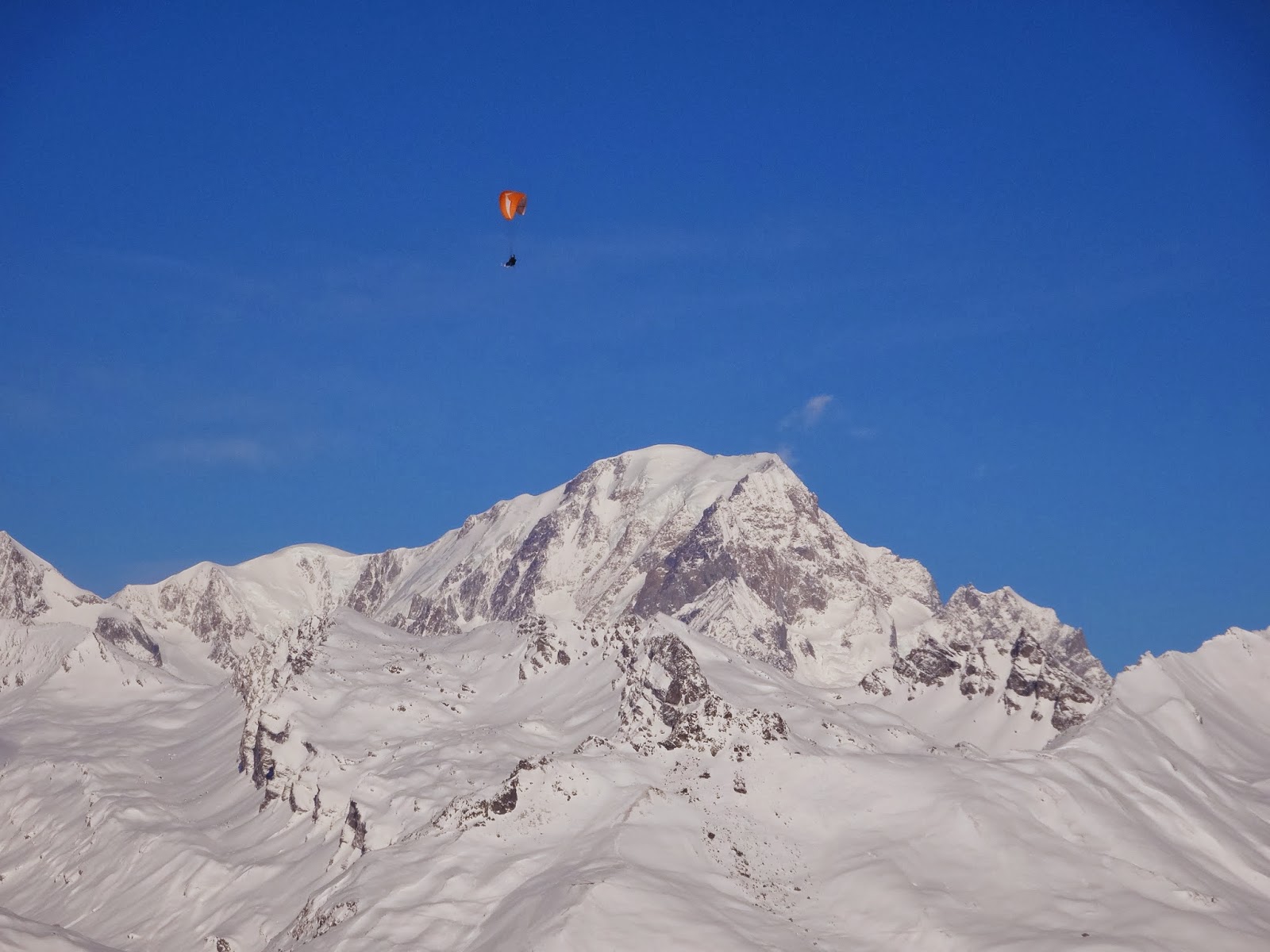
Once I reached the top of the mountain this morning, it became VERY obvious that Mont Blanc had been just right there the whole time.
A paraglider drifts across the Alps


It stands head and shoulders above the other peaks of the region.  Apparently, it rises about 4,800 metres above sea level, though it's height varies from year to year depending on the depth of the summit's snow cap.

This means the top of Mont Blanc is still about another 2,000 metres above me, even though I'm already skiing at between 1,600 metres and 3,000 metres above sea level.

My pictures don't really do it justice, but it's pretty amazing to ski in the shadow of this rocky giant.


Wednesday, 22 January 2014

First time Val d'Isere

It seems to go like clockwork each week.

Every Saturday, most of the population of the ski town of Val d'Isere, France, just leaves, replaced by a new batch of snow seekers.

There's the packs of Brits, the Irish lads, French couples and a potpourri of other Europeans - not to mention the odd Aussie or two like me.


As most of the hotels and units only offer seven night stays with a Saturday changeover, literally everyone seems to arrive and depart on the same day.  It's organised chaos on ice.

There's a frantic energy as the new arrivals raid the supermarket, rent their ski gear, secure their lift pass and check out what else the town has to offer.   There's bars, cafes, patisseries, restaurants, shops and even a cinema.


Despite it's international stature, Val d'Isere is relatively compact.  It is literally a one-street town, with all the shops, hotels and unit blocks radiating from the main road that snakes its way along the narrow valley floor.

High on the mountains above the town, hidden out of view, is 300km of ski slopes.  That's what everyone has come for.

This week was my first time at Val d'Isere.  It's also my first time skiing in Europe so I was keen to see how it compared to its counterparts in Japan, Canada and the US.

Here's seven things about Val d'Isere that are good for first-timers like me to know.


1.  Espace Killy's the ticket
You've got a choice of ski lift passes at Val d'Isere.  You can ski just the Val d'Isere area, or the full Espace Killy ski area that takes in Val d'Isere and the nearby Tignes ski resort.  I opted for the Espace Killy pass and found it just the ticket for discovering all the area has to offer.  It's also pretty easy to "accidentally" end up in Tignes because of the way the runs and lifts fall so it's worth having a ticket for this area.


2.  The early-ish bird catches the worm
As with many ski resorts, those who rise for the day's first lifts are rewarded with uncrowded slopes and maybe untouched powder stashes.  In Val d'Isere this is also true, but thankfully lifts don't open until around 9am.  Even so, many skiers and boarders are busy nursing hangovers for the night before or feel it would be unfashionable to make an appearance before 10.30am, so it's worth making the early effort.


3.  Go high to get out of the clouds
You can be down in the village looking up at cloudy skies, but up another 1000m you're basking in sunshine.   Espace Killy's two highest peaks, La Grande Motte (3656m) and Pointe du Montet (3488m), are the places to be when the clouds hug the lower valley.  The snow is also often in better condition up here (apparently they also offer summer skiing here too).


4.  Tres cher?
I had expected Val d'Isere to be expensive.  Not just because I'm travelling on the "Pacific Peso" (Australian Dollar), but also because it's Europe, it's a ski resort and, hey, it's Val d'Isere.  Interestingly I've found options for all budgets - something that can't be said for all ski resorts.  As an indication, you can score a hot chocolate for anywhere between two and six Euros, depending where you are.  And for a bit of fun, you can check out the price tags on some of the ski gear, some of which goes for the same price as a second-hand car!


5.  Piste potluck
Just in case you temporarily forget where you are, a pitstop at one of the many restaurants or cafes on the mountain or in the village brings you back to reality.  From pain au chocolat and gateaux, to brioche suisse, there's no shortage of French treats for a morning snack.  Lunch and dinners are also a feast with some of the most diverse and tastiest food I've ever had at a ski resort.


6.  It's all about the Alps
One thing that surprised me the most about Val d'Isere is that there are no trees on the slopes.  It's truly alpine, high above the natural tree line.  The advantage of this is that you have expansive peak and valley views as you ski wide runs.  The only downside is during cloudy weather, snowy conditions or flat light when you might normally hunt out tree-lined runs to enhance slope definition and visibility.


7.  Getting home in one piece
One thing about having the slopes several hundred metres above the town is that everyone has to eventually come down.  At Val d'Isere, there's only a handful of runs (mostly intermediate or difficult) that run back to the village and, as you can imagine, these are pretty packed at the end of the day.  If you don't want to take part in the equivalent of the grand prix on skis, take one of the ski lifts or gondolas back down.