Monday, 6 April 2015

Party for one: Eurovision 2015 first listen

Clear the diary.  Turn off the phone.

It's time to dive into this year's Eurovision pool and see what acoustic delights will wash over me.

I've got the songs loaded on my iPod and ready to roar (strap yourselves in neighbours as there's 40 songs).

Apart from Australia's Guy Sebastian, I haven't seen any of the artists so my thoughts are purely based on how the song sounds.

Of course, the performance on the night has the power to make a good song great (and vice versa), but until then, the songs are all we have.

Are you ready?  Here we go!


This year's themes:
1.  A little bit folk / a little bit country
Put away the costume reveals and power down the wind machines during the songs by Cyprus, Hungary and Belarus

2.  About time
Switzerland, Belarus and Lithuania have their eyes on the clock

3.  A trip to the theatre
Some very musical-sounding numbers from San Marino, Norway, Armenia and the Czech Republic

4.  Twice as nice
The male/female duo is back on the Eurovision stage, care of the Czech Republic, Lithuania, Estonia, the UK and Norway

5.  Life is a battlefield
War is on the mind of Hungary, Georgia, France and Malta


My picks
I'm torn about this year's favourite as it's such a diverse crop of songs.  At one end of the spectrum there's some pure pop songs, all the way through to punk and rock.  Amid this indecision, I've selected my top five (The A Squad) and my next top five (The B Squad).

Australia is one of my favourites but as I won't be able to vote for it, I've put it to the side.

The A Squad
Azerbaijan
Iceland
Estonia
Denmark
Netherlands


The B Squad
Lithuania
Germany
Slovenia
Albania
Norway


The Nitty Gritty
Here's my first thoughts on songs as they randomly played:

AUSTRALIA:  "Tonight Again" by Guy Sebastian
This will no doubt sound very biased, but Guy's soulful and upbeat song is a standout among this year's more sombre, reflective and folk offerings from Europe.   His decision not to go with a ballad could prove a winner... but what will the rest of Europe think?

BELARUS:  "Time" by Uzari and Maimuna
Not a bad entry by Belarus (certainly a step up from its "I love Belarus" entry of a few years ago!).   Violinist Maimuna adds a folk feel to this otherwise standard pop song and she could add an extra dimension to the live performance.

AUSTRIA:  "I Am Yours" by The Makemakes
Pity the person(s) that have to follow in Conchita's footsteps.  Austrian pop rock band The Makemakes has been selected for the task.  It's a solid effort, but we're unlikely to be back in Austria in 2016.

ESTONIA:  "Goodbye to Yesterday" by Elina Born and Stig Rasta
After a slow start, this song gets kicking along and tells the story of two lovers the morning after.  The male-female combo is a reminiscent of last year's The Common Linnets from The Netherlands.   This will do well on the night.

POLAND:  "In the Name of Love" by Monika Kuszynska
Departing from last year's big breasted milk maids churning butter, Poland presents us with a traditional love ballad.  Nice enough but could be easily forgettable on the night.

BELGIUM:  "Rhythm Inside" by Loic Nottet
This beat-driven Belgian offering has potential.   Hey, at least it's not a durgy love song.   Sounds fresh and could put on a good show on the night.

ROMANIA:  "De La Capat" (All Over Again) by Voltaj 
I'm always impressed when countries offer a song in their native tongue.  There was a bit of controversy around this one as the band originally planned to sing the English version of this song but local outcry prompted a compromise with the Romanian/English version.   It's a pretty song and should do well.

SLOVENIA:  "Here For You" by Maraaya
A boppy ditty that comes with a side serve of soul.  I like.

DENMARK:  "The Way You Are" by Anti Social Media
I get a One Direction / The Monkeys / Partridge Family vibe listening to this tune.  There's a '60s pop rock jauntiness that's very listenable and catchy.   Once again, in a year where "feel good" songs are few and far between, this could really stand out.

THE NETHERLANDS:  "Walk Along" by Trijntje Oosterhuis
A strong song about unrequited love from The Netherlands.  Thankfully not a dreary offering, but could really come alive on the Eurovision stage.


ITALY:  "Grande Amore" by Il Volo
Three young guys singing popera; Italy's aiming straight for Europe's voting heart with this dramatic-sounding song.   It should do well if the harmonies work on the night.

GERMANY:  "Black Smoke" by Ann Sophie
Ann sounds very Paloma Faith / Amy Winehouse in this cool track.   I really like it.  Interestingly the artist who original won the title to represent Germany this year pulled out, leaving Ann with the job.

RUSSIA:  "A Million Voices" by Polina Gagarina
For a "We are the world"-type song, this is a pretty good offering.   Polina sounds really strong and the pretty melody and lyrics wouldn't be out of place at an Olympic opening ceremony.   But how will Europe feel about a Russian entry singing about love, peace and unity?

SAN MARINO:  "Chain of Light" by Michele Perniola & Anita Simoncini
I initially thought my iPod had skipped onto a soundtrack from a musical.  This song has a very theatrical feel to it at the start, before transitioning into a '80s pop song.   It's not the best.

CZECH REPUBLIC:  "Hope Never Dies" by Marta Jandova & Vaclav Noid Barta
Ok.  So I had to double check I wasn't listening to a musical rather than Eurovision.   Vaclav has quite the gravelly voice and the song never seems to get going.  Shame as this is only the fourth ever Eurovision outing for the Czech Republic and the first time they've competed in the contest in six years.

PORTUGAL:  "Ha Um Mar Que Nos Separa" (A Sea That Separates Us) by Leonor Andrade
Non-English songs can still be catchy and capture the audience's attention.  Sadly this is not one of those songs.   You almost tune out as you listen.   Perhaps this is the song you pop to the bathroom during?

IRELAND:  "Playing With Numbers" by Molly Sterling
A sweet song from Molly and nice to see Ireland not going crazy (Jedward) or uber traditional (cue the fiddles).

MACEDONIA:  "Autumn Leaves" by Daniel Kajmakoski
A strong entry about a broken heart from Macedonia that should do well.

SERBIA:  "Beauty Never Lies"  by Bojana Stamenov
I feel a costume reveal coming on.  This self-affirmation song starts slow, but then a '90s' techno beat strikes up and I'm sure a wind machine will.   This seems one of the few dance entries this year.

ALBANIA:  "I'm Alive" by Elhaida Dani
A powerful and passionate entry from Albania.  It's a good one.

Eurovision 2014 winner Conchita

UK:  "Still In Love With You" By Electro Velvet
A kind of electric jazz,  it's an inoffensive and uptempo song but unlikely to deliver the return of Eurovision to the UK.

ICELAND:  "Unbroken" by Maria Olafsdottir
Iceland has given us great entries for a couple of years and this song doesn't disappoint.  I can imagine this being a Taylor Swift song.  With strong lyrics and a powerful melody, it could be propelled into the winner's position.

HUNGARY:  "Wars For Nothing" by Boggie
I feel there should be an apostrophe before the "s" but this seems to be how the band has lodged the song.  It's a melodic folk song - the kind you would sing during a candlelight vigil somewhere - but I'm not sure it's going to set the Eurovision stage on fire and could just be seen as a little preachy.

SWEDEN: "Heroes" by Mans Zelmerlow
I'm normally a big fan of Sweden as they always deliver great pop songs (hello Loreen!), but this year's entry leaves me a little cold.   The verse sounds country, but the chorus is more athematic.  Maybe I'll warm to it with a live performance?

NORWAY: "A Monster Like Me" by Morland and Debrah Scarlett
Another song that would fit in on the West End stage.  This is quite a pretty song about being unworthy of each other's love.  Starts of slowly, but has a powerful finish.

ISRAEL:  "Golden Boy" by Nadav Guedj
I don't like this song.  It starts off ok with soulful wailing about having a broken heart.  But then it somehow evolves into a Kanye West / Bollywood standard.  Pass.

MOLDOVA:  "I Want Your Love" by Eduard Romanyuta
A decent pop song that would have done well in the late '90s/early '00s.  However, I suspect it's the kind you forget as soon as the track ends.  Still, it should provide some light relief on the night.

AZERBAIJAN:  "Hour of the Wolf" by Elnur Hseynov
Does Azerbaijan sink most of it's national budget into Eurovision?  Probably.  Still, it works.  I love this song.  It's a soaring, contemporary ballad that has a strong melody and could really pack a punch on the night.

CYPRUS:  "One thing I Should Have Done" by John Karagiannis
A simple and sweet song about love regret.   Being accompanied only by a guitar gives the song a folk feel.  People have likened it to Extreme's "More than Words".

LATVIA:  "Love Injected" by Aminata
A little too post modern for me.   Lots of quirky electric sounds, but a lack of lyrics and melody, and an uninteresting chorus makes the three minutes seem longer.  We're unlikely to be in Latvia next year.

Eurovision 2015 stage design

GEORGIA:  "Warrior" by Nina Sublatti
This must be the Eurovision equivalent of turning up to a function in the same outfit; two entrants have songs called "Warrior".   Georgia's entry is pulsating pop, but will the name confusion cost it points?   I wonder what the other one sounds like?

GREECE:  "One Last Breath" by Maria Elena Kiriakou
Let's get the obvious joke out of the way first: this could be a love song or commentary about the Greek economy.   It's a simple ballad that builds momentum, but it's unlikely go anywhere on the night (probably just as well as I'm not sure Greece is ready to fund/host Eurovision).

SWITZERLAND:  "Time to Shine" by Melanie Rene
A solid pop rock entry from Switzerland, complete with an electric guitar solo.  This could do well for Switzerland.

LITHUANIA:  "This Time" by Nokia Linkyte and Vaidas Baumila
This song is growing on me.  It's a rollicking, guitar-centric song about falling in love that could have Europe doing the same with this duo.

MONTENEGO:  "Adio" (Goodbye) by Knez
One of the few non-English songs in this year's pile.  It's a tune that builds but I'm not sure it has a strong enough melody to transgress the language divide.

MALTA:  "Warrior" by Amber
The other song called Warrior.  I think I prefer Georgia's "Warrior", though both seem to be about finding the warrior within.  Amber gets a bit shouty in parts.

ARMENIA:  Face the Shadow" by Genealogy
Lots of voices spring up in this one (including an opera singer it seems) and (again) could be the Act One finale of a musical.  More doesn't necessarily mean better.  I don't like this one so much.

FINLAND:  "Aina Mun Pitaa" (I Aways Have To) by Pertti Kurkan Nimipaivat
Well if you've ever wondered what a Finnish punk band consisting of people with disabilities sounds like, then this song is for you.  It goes for a mere 1.24 minutes and seems to just repeat the title throughout.  I'm all for inclusion, but at the end of the night the song needs to stand up on its own.  Nope.

SPAIN:  "Amanecer" (Break of Day) by Edurne
This quickly builds from a fairly dreary start to solid and racing tune, sung in Spanish.

FRANCE:  "N'oubliez pas" (Don't Forget) by Lisa Angell
A good entry from France, sung entirely in French.   Lisa's soulful voice carries the simple tune about rebuilding our lives after war.  It takes on more significance after the events in Paris during the past year.


Monday, 16 March 2015

Rock of ages

We were having one of those travel moments when we knew what we were looking for, but weren't sure what it looked like, and were concerned we had passed it.

But then, my friend and I gazed to the right and immediately spotted it:  Ireland's Rock of Cashel.  

In hindsight, we needn't have worried about missing it.

This is no pebble by the roadside, but a sizeable fortress mound with castle and cathedral ruins on top.   It would be pretty hard to miss... even for us.


First glimpse:  Rock of Cashel 

On the approach

The Rock of Cashel, nestled beside the town of Cashel, is also known locally as Cashel of the Kings and St Patrick's Rock.

According to legend, the rock comes from a nearby mountain, called the Devil's Bit.  When St Patrick banished Satan from a cave in the mountain, the rock was thrown to it's current site.

This is also where St Patrick was believed to have converted the King of Munster.  

Clearly St Patrick was a bit of an overachiever and hit his stride at Cashel.

Inside the ruins

We're at Cashel on a beautiful Irish autumn day - it's mostly cloudy, a little cool and with periods of light drizzle.   The weather sets the mood of this place perfectly.


Rock of Cashel is a mash of mostly ruined buildings that map its history.  Each crammed against each other, leaning and partially blending into each other.

Among the pack are a 12th century round tower, a 13th century Gothic cathedral and 15th century castle.

Importantly, there's enough remaining to give us a tantalising taste of what life might have been like here hundreds of years ago.  With the harsh Irish weather, and cool and dark castle interiors, this would have been no place for the faint hearted.


But for me, one of the best sites at Rock of Cashel is the graveyard nestled beside the ruins, complete with moss-covered headstones tilted to the side.  

Traditional Irish high crosses stand tall here, casting their eye over the region's impossibly green fields.

Heading out to the graveyard


Sunday, 8 March 2015

Australia's Eurovision 101

Australia is on tenderhooks.

This week the nation finds out which song Guy Sebastian will be singing to represent Australia in Eurovision.

I don't want to exaggerate, but this could be the biggest Australian news event of the year.

After all, this is the first (and possibly last) time Australia will be competing in Eurovision.

Guy Sebastian to represent Australia
The announcement of Australia's participation in this year's competition in Vienna, and subsequent appointment of Guy Sebastian as our chanteur of choice, has generated much discussion and confusion Down Under.  

It's all new to many Australians and there are lots of questions.

To bring Australia up to speed on this Eurovision caper, I've compiled a list of Frequently Asked Questions.


Q:  Australia is not in Europe so how can it be in Eurovision?
You're right!   Australia isn't in Europe so rest assured that your grade five geography teacher didn't lie to you.  

Still, the European Broadcasting Union (EBU), the group that puts on Eurovision, decided to give Australia a "wildcard" entry this year to mark the contest's 60th anniversary.   Given the aim of Eurovision is to bring nations together, inviting Australia to take part seems very apt, don't you think?

Pack your bags Australia, we're off to Europe!

Helping this decision would have been the fact that Australia is the largest Eurovision audience outside of Europe and has been screened here for 30 years.   In recent years, our interaction with the competition has grown.  In 2013, the Malmo hosts gave a nod to Australia, while last year Jessica Mauboy provided half-time entertainment in Copenhagen.  


Q:  Why does Eurovision exist?
It was started in 1956 by the European Broadcasting Union as a way to unite war-torn Europe through light-hearted entertainment.   Think of it as the musical equivalent of the Olympics.

Interestingly, during the Cold War the Soviets tried to start their own version of Eurovision, called Intervision.


Q:  How does Eurovision work?
Each year, member nations of the EBU submit a song to be performed live during the contest.   With about 40 countries competing, there are two semi-finals and a grand final.   

Each country casts votes for their favourite song, awarding 12 points to their top pick, then ten points to second choice, and then eight to one points for the following eight songs.  Countries can't vote for themselves.

Each country determines their favourites by a combination of telephone votes and the votes of a jury, made up of music figures from that country.  The purpose of the jury is to lessen the impact of "bloc voting" (where countries just vote for their neighbours).  

The presentation of votes from 40-odd countries has taken on a life of its own in recent years, consuming quite a bit of time as the show crosses live to representatives in each country (often former Eurovision performers from that country or "local identities").

The winning country hosts the competition the following year.  Here are some common techniques countries use to try and win Eurovision.
We've been watching for 30 years

Q:  Isn't Eurovision a bit of a joke?
I can't deny that with the wind machines, costume reveals and other gimmicks, some acts are more of a novelty than others.  But just because it is a competition, doesn't mean it can't be fun. 

If you listen to some of the most popular picks from recent years, they have been strong songs from a range of genres, from pop and rock, through to folk and country.  Many have found wide appeal outside of Eurovision, even charting on iTunes Australia.


Q:  Why do some countries skip straight to the grand final?
The UK, France, Germany, Spain and Italy (known as the "Big Five"), along with the host nation, go straight to the grand final because they are the biggest financial contributors to the EBU.   

As a "wild card" entry, Australia will also skip the semi-finals and only perform in the grand final.


Q:  How do countries pick their songs?
Each country (well their Eurovision TV broadcaster) picks their Eurovision entry.  For some countries, such as the UK, the broadcaster simply picks who will represent the nation.   In other countries, the national selection process takes months of X Factor-style performances and public voting.

In Australia, the broadcaster SBS appointed Guy Sebastian as our representative after calling for expressions of interest from the local music industry.   The fact that Australia only knew quite recently that it was going to compete ruled out a public national selection process.


Q:  Have Australians participated in Eurovision before?
Why yes, but not representing Australia.  Olivia Newton John represented the UK in 1974, Johnny Logan won Eurovision for Ireland twice, Gina G represented the UK in 1996, and Jane Comerford was the lead singer for German entry Texas Lightning in 2006.

Jessica Mauboy in 2014

Q:  What else do I need to know
As with all competitions, there are a number of interesting rules: 
  • The songs must not have been commercially released before 1 September 2014
  • Each song can only last three minutes
  • A maximum of six people can be on stage during a country's performance.  The rules explicitly forbid live animals on stage
  • All artists must be at leat 16 years old
  • No one artist can compete for more than one country in any given year (but a country's representative doesn't have to have been from that country... hence Australians have been able to compete for other countries)
  • Songs must have lyrics and each country can decide the language they want their song to be in 
  • Each song must be performed live (there can be no vocals on the backing track)
  • Songs can't have "unacceptable language" or promote any organisation, institution, political movement, brand, produces or services
  • Each participating broadcaster is required to broadcast the show in its entirety (so countries at conflict with their neighbour still have to show their entry) 

Monday, 9 February 2015

Colorado calling

"I'm leaving on a jet plane,
Don't know when I'll be back again.
Oh babe, I hate to go."

With my bags packed and these words from John Denver ringing in my ears, today I'm saying farewell to the slopes of Colorado.

It's been my second visit to the US state and another chance to explore more of the many ski fields it has to offer.


Featuring large international resorts like Vail, Aspen and Breckenridge, along with smaller "local mountains" like Copper Mountain and Keystone, you can barely move here without tripping over a ski hill.

Surprisingly, skiing in Colorado is different compared to other snowy destinations.

Sure, it's got the snow, but it's the type of skiing, environment and surrounding towns that make Colorado stand out.

Here's a few ways Colorado skiing is different:

1.  You get high
With Southern Rocky Mountain elevations of more than 3,000 metres above sea level, you're considerably higher than ski resorts in Japan, Australia and New Zealand.

For some this means a healthy dose of altitude sickness when they first arrive.  For me, it means a constant shortage of breath, whether it's walking up short flight of stairs or through the supermarket.

Breckenridge - proudly home to the highest ski lift in North America

Heading down from that lift
2.  You get high (part two)
Since my last visit, Colorado has legalised marijuana so a few cannabis cafes have sprung up.  Sure, there's always been an acrid whiff of pot around ski lifts, but now that seems to have grown into a cloud of smoke hanging over the state.  You smell it corridors, walking along the street, on the bus and on people's clothes.


3.  Sunshine on my shoulders
The local guide tells me Colorado gets almost 300 days of sunshine a year, yet it also manages to be one of the snowiest places in the US with annual snowfalls of up to nine metres.  On this visit, there were a few sunny days when the temperature crept up above zero (never a good thing for snow), but on the plus side I do enjoy seeing where I'm going when skiing.


4.  Tree-lined runs
Many places have tree-lined ski runs, with the resorts in the US and Canada known for their network of trails among the pine forests.  In Colorado, they not only have the usual pine trees, but they also have forests of aspen trees, which have a luminous bark in the snow.   Very pretty.


Aspens

5.  Rocky Mountains
True to name, there are plenty of jagged peaks, canyons and cliffs in this part of the world.  A dusting of snow makes these all the more dramatic.   On some of the more advanced ski runs, there's also a few rocks peeking through ready to scrape against your rental skis ("That gash was there when I picked the skis up," I claim).


6.  Hoedown throw down
Long before the invasion of skiers and boarders in flash 4WDs ready to pay through the nose for something basic like a soft drink, this was cattle and mining country.  Many of the buildings look like they're remnant sets from a western movie, while it's not unusual to see a few locals skiing in cowboy hats and flannel shirts.


The town of Steamboat Springs with the ski runs as the backdrop
7.  It's dry
The altitude and low humidity means you quickly become a walking ball of static electricity, ready to zap anyone or anything at a moment's notice.  It also means you wake up desperate for a glass of water a few times a night, and have to contend with the occasional nose bleed.


8.  The views
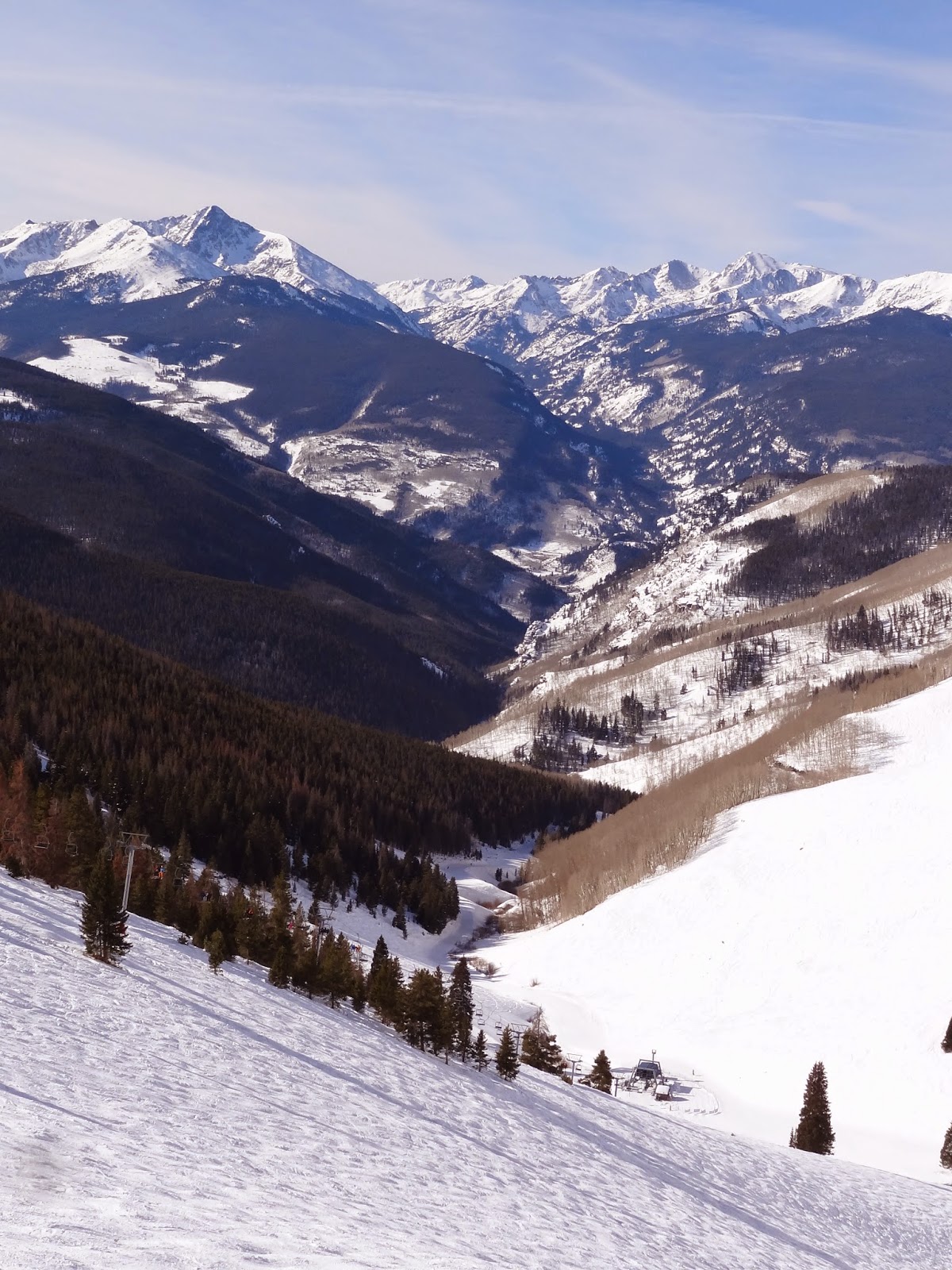
While you're smack bang in the middle of the US, sometimes it feels like are in the middle of nowhere.  You can be standing on top of a mountain and see nothing but rugged peaks and valleys for as far as the eye can see.


Saturday, 7 February 2015

Shrines in the snow

"I'm looking for John Denver," I asked one of the Aspen Mountain Ambassadors.

Anywhere else in the world and this request would have justifiably been met with a puzzled look.  After all, John sadly died almost two decades ago.

But without missing a beat, Ambassador Kyle jumped on his skis and led me towards a blue run called "Bellissimo".
The view from Aspen Mountain across to Aspen Highlands

Tucked in the trees alongside this run is a peaceful shrine dedicated to the late Colorado singer.

The shrine consists of photos, album covers and other John Denver paraphernalia that fans have left on the trees over the years in remembrance and celebration of the former Aspen local.

The John Denver shrine

It's a quiet little spot among a slightly steep clump of trees that ensures I awkwardly slip and slide my way in for a closer look.


But the John Denver shrine is just one of many hidden among the slopes of Aspen's four ski hills, though most seem to be on Aspen Mountain which towers over the town.


There's shrines to lots of famous people and things, from the Beatles through to Snoopy.

Nobody knows for sure, but the shrines were started years ago by anonymous individuals and evolve over time as people contribute and take items.

They add a surprisingly spiritual and reflective atmosphere to the mountains, and as far as I'm aware are unique to Aspen and its four ski hills.

Aspen Mountain overlooking the town of Aspen

One local, David Wood, has categorised as many as he can find on a website.

But no matter how good a description you may discover for these shrines, asking one of the friendly Aspen Ambassadors to show you is the sure fire way you will actually find them.  After all, there are a lot of trees here.

Kyle then leads me down a black run filled with icy moguls - a run I would not have bothered with by myself.

Here, in a little clearing offering a panoramic outlook over the valley, is the shrine dedicated to Jerry Garcia from the Grateful Dead.

The Jerry Garcia Shrine
I have to confess that I'm not really familiar with that band, but I can appreciate that this is one of the most substantial shrines on the mountain.

There's photos, lyrics and a even a guitar hanging from a tree.

Guitar hanging at the Jerry Garcia Shrine
To complete the picture, when we arrive two old stoners are sitting on a log smoking a joint and taking a swig from the whiskey bottle they brought.   I quietly hope I don't encounter their boozed and high skiing later on.

They read some Grateful Dead lyrics to me as if they were the words of Shakespeare and I fake enthusiasm about how profound they are.

My next shrine stop is not dedicated to a person or group, but to an event; the 9/11 attacks in New York.

This shrine is visible from the nearby ski runs, particularly a large engraved wooden sign.

The 9/11 Shrine on Aspen Mountain
Tributes to the firemen involved in 9/11
Apparently there are almost 75 shrines in the trees on Aspen's four ski hills.

The people who started them did not intend for them to be tourist attractions and there are no maps pointing out their locations.

Instead, inspired by the beautiful natural landscape, they simply created spots to pause and remember someone or something that was dear to them.